



Understanding software requirements is one of the most important parts of working with Python-based applications, especially when dealing with niche tools, custom frameworks, experimental builds, or coded modules identified with technical naming conventions such as 5AH9.6MAX0.
Many users searching for “what are 5AH9.6MAX0 Python software requirements” are typically trying to determine whether their system can properly install, run, or support a Python-driven software environment. In practice, this often involves checking Python versions, operating system compatibility, required libraries, hardware capacity, and runtime dependencies.
Definition:
The term “what are 5AH9.6MAX0 Python software requirements” refers to the set of technical conditions needed for a Python-based application or module to function correctly. These requirements normally include, for example: supported versions of Python, package dependencies, system resources, environment variables and operating systems.
Table of Contents
Understanding Python Software Requirements
Python applications rarely operate alone. Most modern Python systems rely on external libraries, frameworks, APIs, and supporting runtime components.
For example, a software package may require:
- Python 3.10 or later
- Specific pip packages
- Database connectivity
- API integrations
- Operating system permissions
- GPU or CPU compatibility
- Virtual environment support
Without these components configured correctly, software may fail to install or run properly.
What Are 5AH9.6MAX0 Python Software Requirements?
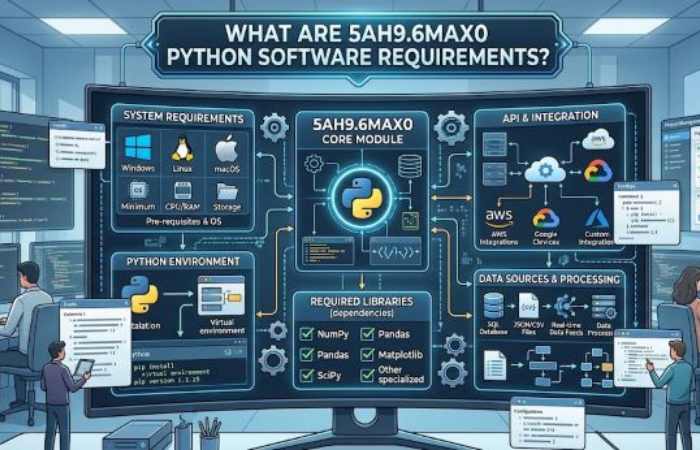
Although 5AH9.6MAX0 does not appear to represent a widely standardised public framework, the structure suggests a technical build identifier, internal package label, or custom software module associated with Python development environments.
In most cases, software requirements for this type of Python-based system may include the following categories.
Core Requirements
| Requirement Type | Typical Expectation |
| Python Version | Python 3.9+ or newer |
| Package Manager | pip or Conda |
| Operating System | Windows, Linux, or macOS |
| RAM | 4GB minimum, 8GB preferred |
| Storage | 1–5GB free space |
| Internet Access | Required for dependency installation |
| IDE Support | VS Code, PyCharm, Jupyter |
These are general expectations rather than guaranteed specifications, especially for custom software environments.
Common Python Environment Components
Python software systems usually depend on several connected tools working together.
1. Python Interpreter
The interpreter executes Python code and provides the runtime environment.
Common supported versions include:
- Python 3.9
- Python 3.10
- Python 3.11
- Python 3.12
Older versions may create compatibility problems with modern libraries.
2. Package Management Tools
Most Python software uses package installers such as:
| Tool | Purpose |
| pip | Installs Python packages |
| Conda | Environment and package management |
| Poetry | Dependency management |
| virtualenv | Isolated environments |
These tools help avoid conflicts between projects.
3. Development Environment
Developers often use integrated development environments (IDEs) for configuration and debugging.
Popular examples include:
- Visual Studio Code
- PyCharm
- Jupyter Notebook
- Spyder
Typical Installation Workflow
Python setup usually follows a predictable workflow.
5AH9.6MAX0 Python Software Setup Workflow
| Step | Purpose |
| Install Python | Enables runtime execution |
| Configure PATH variables | Allows command-line access |
| Install package manager | Handles dependencies |
| Create virtual environment | Prevents library conflicts |
| Install required packages | Supports software functionality |
| Run configuration tests | Confirms setup success |
This process may vary slightly depending on operating system and project complexity.
Operating System Compatibility
Compatibility is often one of the biggest concerns when installing Python software.
| Operating System | Compatibility Notes |
| Windows 11 | Commonly supported |
| Windows 10 | Widely compatible |
| macOS | Usually supported with version-specific adjustments |
| Ubuntu Linux | Frequently preferred for development |
| Fedora/Debian | Often compatible |
Some advanced modules may require Linux-based environments for full functionality.
Hardware Requirements and Performance Expectations
Performance depends heavily on what the software actually does.
Lightweight Python Tools
Examples:
- Automation scripts
- Data parsers
- Small utilities
Typical needs:
- 4GB RAM
- Standard CPU
- Minimal storage
Heavy Python Workloads
Examples:
- Machine learning
- Data science
- AI inference
- Large databases
Typical needs:
- 16GB+ RAM
- Multi-core processors
- GPU acceleration
- SSD storage
Users searching for “what are 5AH9.6MAX0 Python software requirements” should consider workload intensity before expecting high performance on entry-level systems. For more related articles, visit our website
Dependency Management Explained
Dependencies are external libraries required for software functionality.
Example Dependency Categories
| Category | Examples |
| Data processing | pandas, NumPy |
| Web frameworks | Flask, Django |
| AI libraries | TensorFlow, PyTorch |
| Visualisation | Matplotlib |
| Networking | requests |
| Database access | SQLAlchemy |
If dependencies are missing or incompatible, the application may generate runtime errors.
Comparing Virtual Environments vs Global Installation
One of the most important setup decisions involves environment management.
| Feature | Virtual Environment | Global Installation |
|—|—|
| Package isolation | Yes | No |
| Reduced conflicts | Strong | Weak |
| Easier testing | Yes | Limited |
| Beginner simplicity | Moderate | Simple |
| Recommended for projects | Yes | Not always |
Virtual environments are generally considered best practice for modern Python development.
Security and Legitimacy Considerations
When dealing with lesser-known software identifiers such as 5AH9.6MAX0, users should verify legitimacy carefully.
Recommended Safety Checks
- Download software only from trusted repositories
- Review dependency documentation
- Scan executable files when applicable
- Avoid unknown scripts from unofficial forums
- Check GitHub activity and maintenance history
- Confirm package authenticity
Some Python packages may include outdated or poorly maintained dependencies that create security concerns.
Common Installation Problems
Python environments are powerful but sometimes frustrating for beginners.
Frequent Issues
| Problem | Possible Cause |
| “Module not found” errors | Missing dependencies |
| PATH variable problems | Python not configured correctly |
| Version conflicts | Incompatible package versions |
| Installation failures | Outdated pip installer |
| Permission denied errors | Admin restrictions |
| Slow performance | Insufficient hardware |
Troubleshooting often requires patience and systematic testing.
Realistic Expectations for Python Software Performance
It is important to avoid unrealistic assumptions.
What Users Can Expect
- Flexible development workflows
- Broad library support
- Cross-platform compatibility
- Strong automation capabilities
What Users Should Not Expect
- Zero setup complexity
- Perfect compatibility across all systems
- Instant high performance on low-end hardware
- Automatic dependency resolution in every case
Python is widely accessible, but complex environments still require technical understanding.
Who Should Use Advanced Python Environments?
Suitable Users
- Software developers
- Data analysts
- Automation engineers
- AI researchers
- Students learning programming
- Technical hobbyists
Users Who May Struggle Initially
- Complete beginners with no command-line experience
- Users unfamiliar with package management
- Users expecting fully automatic installation
Learning Python environments gradually is usually more effective than trying to master everything at once.
Use-Case Examples
Example 1: Data Analysis Workflow
A user running analytics tools may need:
- Python 3.11
- pandas
- NumPy
- Jupyter Notebook
Example 2: AI Development Setup
An AI-focused environment might require:
- GPU drivers
- CUDA support
- PyTorch
- TensorFlow
Example 3: Web Application Deployment
A backend developer may install:
- Flask
- Django
- Gunicorn
- PostgreSQL connectors
Different workflows create very different system requirements.
Alternatives to Complex Local Python Installations
Some users prefer simplified cloud-based environments.
Common Alternatives
| Platform Type | Advantages | Limitations |
| Google Colab | No local setup | Internet dependent |
| Replit | Beginner-friendly | Limited performance |
| Docker containers | Consistent environments | Steeper learning curve |
| Cloud servers | Scalable | Ongoing cost |
These options can reduce compatibility problems for some users.
Best Practices for Managing Python Software Requirements
Keep Python Updated
Newer Python versions often improve security and compatibility.
Use Requirements Files
Files like requirements.txt help maintain consistent environments.
Avoid Installing Everything Globally
Project isolation reduces long-term conflicts.
Back Up Working Environments
Stable setups should be documented and reproducible.
Read Official Documentation Carefully
Most installation problems occur because important setup instructions are skipped.
Is 5AH9.6MAX0 Python Software Legitimate?
The ID itself however does not seem to relate to a known public Python framework as of writing. It may represent:
- An internal software build
- A project-specific module
- A development identifier
- A proprietary package reference
Users should therefore approach unknown software cautiously and verify sources before installation. Legitimate Python software typically includes:
- Clear documentation
- Installation instructions
- Maintained repositories
- Transparent dependency lists
- Community support channels
FAQ’S
What are 5AH9.6MAX0 Python software requirements?
The phrase usually refers to the technical dependencies, system compatibility conditions, and runtime setup needed for a Python-based software environment or module.
Does 5AH9.6MAX0 require Python 3?
Most contemporary Python software program surroundings need Python 3.9 or fresher for compatibility and security explanations.
Can beginners install Python software environments?
Yes, although beginners may encounter challenges related to package management, dependencies, and environment configuration.
Why do Python dependency conflicts happen?
Battles usually occur when multiple letters require different forms of the same public library.
Is a virtual environment necessary?
It is not always mandatory, but virtual environments are strongly recommended for cleaner project management.
Conclusion
It is important to know what are 5AH9.6MAX0 Python software requirements. The requirements to run Python today are not just about running the Python program but also versions of Python itself, package management systems, compatible OS and structured dependency management.
For most users, success hinges on best practices: having realistic expectations, managing workflows effectively, and confirming provenance before the software is installed. Unlike simple scripts or compiler-based programs, managing environments will always be one of the most important elements in professional Python software.